
Producto añadido correctamente a su carrito de compra
Cantidad
Total
Hay 0 artículos en su carrito. Hay 1 artículo en su carrito.
Total productos:
Total envío: A determinar
Total

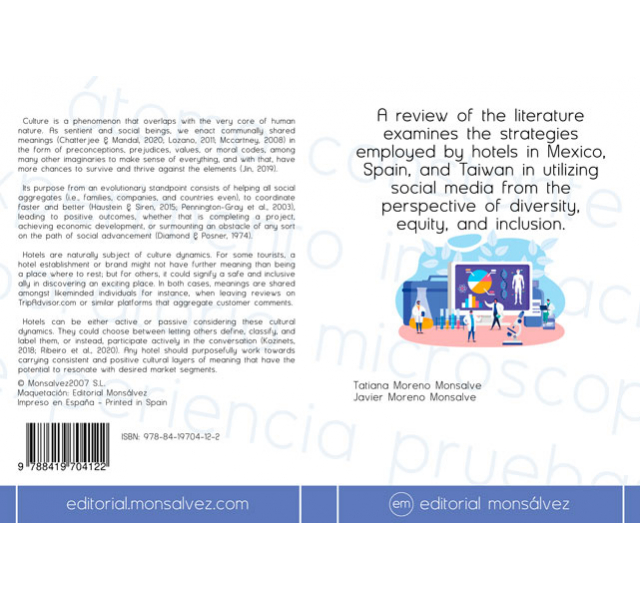
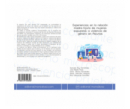
A review of the literature examines the strategies employed by hotels in Mexico, Spain, and Taiwan in utilizing social media from the perspective of diversity, equity, and inclusion.
PUB20230078
28,69 € iva inc.
iva inc.
Culture is a phenomenon that overlaps with the very core of human nature. As sentient and social beings, we enact communally shared meanings (Chatterjee & Mandal, 2020; Lozano, 2011; Mccartney, 2008) in the form of preconceptions, prejudices, values, or moral codes, among many other imaginaries to make sense of everything, and with that, have more chances to survive and thrive against the elements (Jin, 2019).Its purpose from an evolutionary standpoint consists of helping all social aggregates (i.e., families, companies, and countries even), to coordinate faster and better (Haustein & Siren, 2015; Pennington-Gray et al., 2003), leading to positive outcomes, whether that is completing a project, achieving economic development, or surmounting an obstacle of any sort on the path of social advancement (Diamond & Posner, 1974).Hotels are naturally subject of culture dynamics. For some tourists, a hotel establishment or brand might not have further meaning than being a place where to rest; but for others, it could signify a safe and inclusive ally in discovering an exciting place. In both cases, meanings are shared amongst likeminded individuals for instance, when leaving reviews on TripAdvisor.com or similar platforms that aggregate customer comments.Hotels can be either active or passive considering these cultural dynamics. They could choose between letting others define, classify, and label them, or instead, participate actively in the conversation (Kozinets, 2018; Ribeiro et al., 2020). Any hotel should purposefully work towards carrying consistent and positive cultural layers of meaning that have the potential to resonate with desired market segments.
| Impresión Página | Doble Cara |
| Páginas | 61 |
| Tipo Libro | Papel |
| Tamaño | A5 |
| Tipo Impresión | B/N |
| Fecha de Publicación | 09/06/2023 |
| Tipo Carátula | Científicos |
| ISBN | 978-84-19704-12-2 |
No hay reseñas de clientes en este momento.






 Whataspp Live Chat